
Casino Payment Limits and Daily Caps Explained

In the world of online casino and gambling payments, understanding how money moves is just as important as understanding how the platform works. Bright Side of News has found that many players notice limits on deposits, withdrawals, or transfers without clearly knowing why those controls exist. In most cases, these limits are rule-based controls built to support fraud prevention, compliance, and safer account management.
This guide provides a detailed and technical breakdown of payment limits on online casino and gambling platforms, focusing on daily caps, verification checks, and automated triggers. The aim is to explain how these controls work behind the scenes and why they matter in regulated payment environments.
Rules differ by operator, payment method, and jurisdiction, so payment limits and verification checks should be understood as common system patterns rather than universal rules.
In some jurisdictions, including parts of Asia, payment restrictions may also be influenced by local laws. For example, certain countries restrict or block transactions linked to unlicensed gambling platforms, which can directly affect deposits and withdrawals.
What Payment Limits Mean on Gambling Platforms
Payment limits refer to the maximum amount of money a user can transact within a specific period. These limits can apply to deposit limits, withdrawal limits, transaction limits, transfers, or even spending within a platform.
From a technical point of view, payment limits are enforced by payment processors, financial institutions, and platform-level systems. These systems track user activity in real time and apply rules based on predefined policies.
There are several reasons why payment limits exist:
- To reduce fraud and financial abuse
- To comply with financial regulations
- To manage risk exposure for platforms
- To promote responsible financial behavior, including customer-set controls such as the financial limit facilities required under the Gambling Commission’s remote gambling technical standards.
Payment limits are not fixed for all users. In many cases, they may change depending on verification level, account history, payment method, and risk signals.
How Daily Payment Caps Work on Gambling Sites
A daily cap is the maximum amount of money a person can send or receive within a 24-hour window. This is one of the most common types of limits used across platforms.
Inbound Limits (Deposits)
Inbound limits control how much money can be added to an account. For many platforms, this is the first wall a user hits.
- Small Scale: Basic accounts often start with a low daily cap.
- Accumulation: In many cases, limits are cumulative. For example, if a daily cap is 10,000 and 5,000 is added earlier, the remaining allowance may be reduced until the reset point.
- Reset Times: Some systems reset at a fixed time, while others use a rolling 24-hour window depending on platform rules and payment methods. This means the limit may clear 24 hours after the specific transaction, depending on how the platform applies its reset rules.
Outbound Limits (Withdrawals and Transfers)
In some cases, outbound limits may be stricter than deposit limits, especially where additional verification or risk checks are required. Platforms want to ensure that money leaving the ecosystem is going to the right person.
- Daily Cash-Out: This is the total amount a user can move to a bank or e-wallet in one day.
- Single Transaction Limit: Even when a daily cap is relatively high, the system may still allow only a smaller amount per transfer. This adds another layer of control and reduces risk.
Monthly Limits
Beyond the daily cap, there is often a monthly limit as well. Once a user hits a certain total for the month, the account may face added checks or temporary restrictions until a new cycle starts. This can become a common operational hurdle for higher-volume accounts.
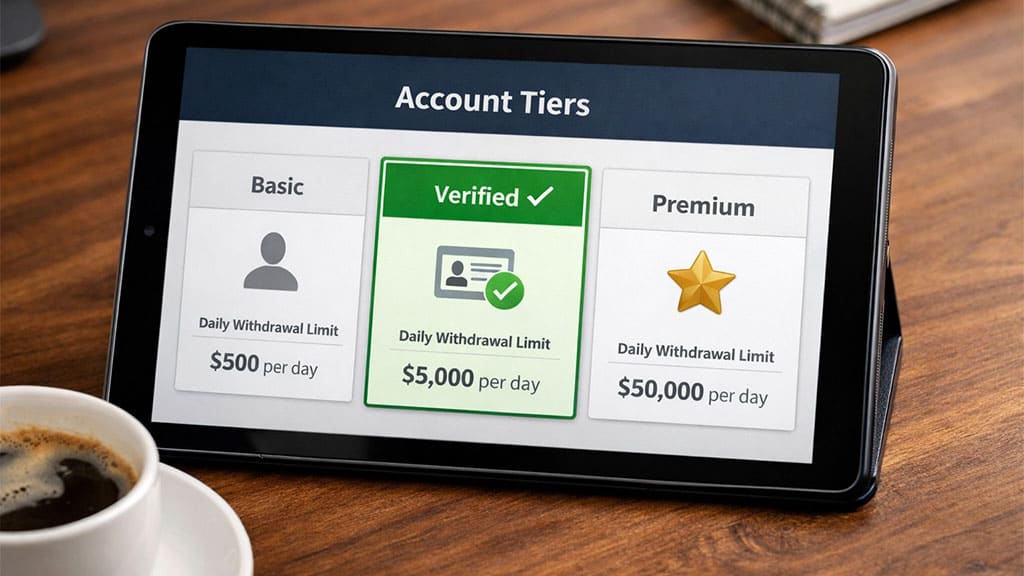
Verification Tiers and Higher Gambling Limits
Verification tiers are a structured way to assign different payment limits based on how much information a user has provided and verified.
What Are Verification Tiers?
Verification tiers are levels assigned to user accounts. Each level comes with specific privileges and limits. In many cases, higher levels of verification may allow access to higher limits, depending on operator policy and regulatory requirements.
Common Tier Structure
While exact structures vary, some platforms use a similar model:
Tier 1: Basic / Limited Verification
When a person first signs up with only basic registration details, the account may begin in a lower-control tier.
- Limits: Usually lower than fully verified accounts.
- Restrictions: Access to deposits, withdrawals, or certain payment methods may be restricted until more checks are completed.
- Purpose: This stage allows the operator to collect more information before higher-value activity is allowed.
Tier 2: ID Verified
To move higher, users may be asked to submit a government-issued ID or pass an electronic identity check.
- Technical Process: The method varies by operator. Some rely on database checks, some ask for document uploads, and some use liveness or selfie checks through third-party tools.
- Limit Increase: Limits may increase after successful verification, but the amount depends on operator policy, payment method, and local rules.
- Capabilities: More payment functions may open at this stage, though not always without further review.
Tier 3: Enhanced Due Diligence
For higher-risk or higher-value activity, platforms may ask for more evidence, such as proof of address or source-of-funds documents.
- Limits: Higher limits may be available, but they are not automatic or universal.
- Manual Review: This stage often involves extra review steps and can take longer because the operator must assess documents and risk context more closely.
Once verification is completed, the system may update the user’s status and adjust limits, although additional checks can still apply depending on risk assessment.

Technical Triggers: Why Accounts Get Flagged
Even if a user stays within their daily cap, certain actions can trigger a “soft lock” or a manual review. This is part of the platform’s Risk Management System.
Velocity Triggers: Velocity refers to how many transaction attempts happen within a short period. Payment and fraud systems often score repeated attempts by card, email, IP address, or other account data. A burst of small transactions can look unusual and may trigger review, especially if it appears designed to avoid normal controls or resembles card-testing or other abusive activity.
Location or Device Mismatches: If an account usually operates from one pattern of devices, IP data, or geography and then suddenly shows a very different pattern, the system may place the activity under review. In such cases, additional verification or a temporary hold may appear while the operator checks whether the activity is genuine.
Pattern-Based Triggers: Repeated behavior, unusual timing, or other consistency issues can also raise flags, but the exact rules vary by operator and payment provider. It is safer to describe these as pattern checks rather than claim that round numbers alone trigger action.
Sudden Spikes: If an account shows activity that is far above its normal pattern, the operator may pause or review the transaction. In a regulated setting, unusual size, frequency, or source of funds can trigger extra checks.
Platforms may ask for extra financial information when activity is high-risk, unusual, or inconsistent with the account’s normal pattern. In some cases, this includes source of funds checks, which look at where the money for a specific transaction comes from, such as salary, savings, or other legitimate income sources. In other cases, it may include source of wealth checks, which look more broadly at how a person built their overall funds or assets over time. These reviews form part of anti-money-laundering controls.

The Role of KYC: How KYC Checks Affect Gambling Payment Limits
KYC (Know Your Customer) is commonly used as shorthand for customer verification and due-diligence checks. In practice, it supports payment access, fraud controls, and anti-money-laundering duties rather than acting as a single standalone step.
- Identity Verification: This is used to check that the customer is the person they claim to be.
- Sanctions Screening: This involves checking whether a person or entity matches designated sanctions lists under applicable laws and controls.
- Risk Assessment: Platforms and payment providers may use risk scoring or rule-based monitoring to decide when more checks are needed. However, the exact model differs by operator, payment partner, and jurisdiction.
How Payment Limits and Delays Are Usually Managed
To understand why delays happen, it helps to look at the usual process behind payment controls, including how casino deposits work behind the scenes. Verification status, payment methods, and reset timing often affect how and when account access changes.
- Early Verification: Completing required checks before higher-value activity starts can reduce the chance of later holds or withdrawal delays.
- Payment Method Consistency: Using payment methods that match the verified account name can lower the chance of extra review, although exact rules differ by operator.
- Reset Timing: If a platform uses daily limits, some systems reset at a fixed time, while others use a rolling time window. This distinction helps explain why a limit may still apply the next day.
Responsible Gambling Limits and Payment Safety
In the context of gambling, payment limits can serve more than one purpose. Some are operator or payment-system controls linked to fraud, compliance, or risk. Others are customer-set tools linked to safer gambling.
For some users, daily or monthly limits may help reduce overspending. In regulated gambling markets, operators may also be required to offer tools that let customers set financial limits on their gambling accounts. It is important to separate these customer-set limits from operator limits and other technical or risk-based restrictions, because they do not serve the same function.
Why Gambling Sites Change Payment Limits Suddenly
Platforms sometimes change user limits without prior notice due to automated risk management systems designed to protect both the platform and its financial partners. At the core of this process is what is commonly referred to as “risk scoring,” a dynamic evaluation model where each user is assigned a continuously updated risk profile based on their transaction behavior.
This score is influenced by several factors, including the frequency of failed or declined payments, the use of multiple or inconsistent payment methods (such as switching between different credit cards or accounts), irregular transaction patterns, and even geographic or device inconsistencies. When the system detects behaviors that deviate from what is considered normal or low-risk activity, it may flag the account as higher risk. In response, the platform can automatically impose stricter controls, such as lowering deposit or transaction limits, to reduce potential exposure to fraud, chargebacks, or financial loss.
These adjustments often occur in real time and without manual intervention, which is why users may not receive advance notice. Ultimately, this approach allows platforms to maintain overall system integrity and compliance with payment processor requirements while managing risk on an individual user level.
Why Gambling Payments Fail, Stall, or Get Delayed
Sometimes a transaction fails even when it appears to be under the stated limit. Here are several technical reasons why this can happen:
- Limit Logic: A transaction may fail because the platform applies a rolling limit, a per-transaction cap, a payment-method cap, or other control that is different from the headline daily number.
- Verification Delay: Electronic checks can be instant, but document review or third-party identity checks can take longer. If verification is incomplete or inconclusive, the payment may be delayed or rejected pending review.
- Mismatched Data: If the name or other key details on the bank account, card, e-wallet, or gambling account do not match closely enough, the transaction may be stopped for further checks.
By recognizing these common causes, including limit logic, verification delays, and data mismatches, readers can better understand why transactions fail even when the displayed cap appears not to have been reached.
In some cases, transactions may also be delayed, reviewed, or blocked as part of payment verification or withdrawal review processes.
Conclusion
Payment limits are an important part of how online gambling payment systems work. Whether the issue involves a daily cap, a monthly limit, or a verification tier, these controls are generally used to protect system stability and reduce payment risk. Understanding verification processes and common triggers can help explain why transactions are sometimes delayed or restricted.
Bright Side of News remains focused on explaining these payment controls in a clear and practical way. It is important to distinguish between operator limits, payment-provider controls, and regulatory checks rather than treat them as one system. Staying informed about these limits can help readers understand why transactions are delayed, restricted, or reviewed. In many cases, verification status, payment-method consistency, and account history all affect what a platform will allow.








Crypto vs E-Wallet Casino Withdrawals: Speed, Fees, Risks Compared

Responsible Gambling Controls in Regulated Markets (UK/AU) and How They Work

10 Best Online Casino Singapore Sites Ranked and Reviewed

Name Mismatch: Why Wallet/Bank Names Must Match Casino Profiles

Best Casino Withdrawal Methods (Speed, Fees, Safety Compared)

AML in iGaming: Common Red Flags That Trigger Reviews

8 Nhà Cái Uy Tín Nhất Hiện Nay Tại Việt Nam Với Ưu Đãi Tặng Tiền Và Tỷ Lệ Cược Hấp Dẫn

How Online Gambling Payments Work Online

Free Credit No Deposit Casino Malaysia 2026: How to Claim RM20+ Bonuses at Trusted Online Casino Sites
