
E-Wallet vs Bank Transfer: Which Is Safer for Withdrawals

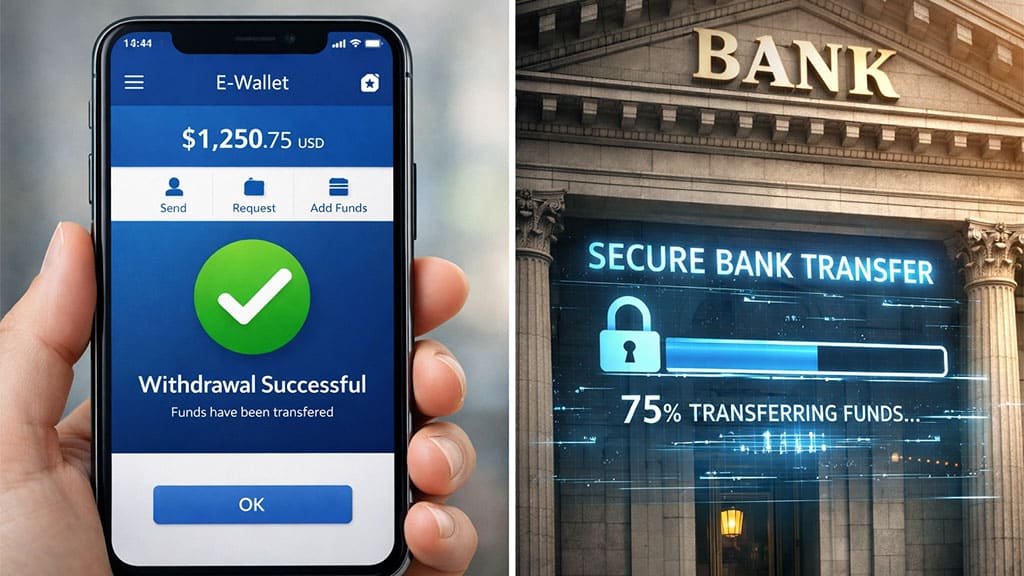
Casino withdrawals are a routine part of online gambling, but the payment route can affect how a payout is reviewed, delayed, or completed. E-wallets and bank transfers are among the most common withdrawal methods. Both are widely used, yet they expose players to different privacy, verification, timing, and payment-processing risks in practice across different markets today.
Bright Side of News reviewed these payment methods to compare privacy, verification, processing time, and failed or delayed withdrawals. This guide explains how each system works, where problems appear, and how those issues are usually handled overall. This comparison looks at withdrawal flow, provider controls, verification requirements, common payment failures, and how payout handling can differ across operators and jurisdictions. Because this guide sits within gambling payment coverage, it focuses on transaction handling, risk, and system behaviour rather than encouraging gambling activity.
This article uses a comparative editorial approach. It looks at provider documentation, banking and payment-process rules, common withdrawal failure points, and regulatory checks that can affect payout handling. The aim is to explain how these systems work in practice, not to promote one payment method over another.
How Casino Withdrawals Work Before a Payout
Before comparing the two methods, it helps to understand the withdrawal chain. After a cash-out request is submitted, the operator may review account details, payment ownership, source of funds, and compliance flags before releasing funds. The payment route then affects how quickly the transfer moves, what data is shared, and where delays, reversals, or extra checks may happen for the player and operator.
Key Factors in Safe Withdrawals
When evaluating safety in withdrawals, several technical and practical factors come into play:
- Transaction Security: How well the method protects against unauthorized access and fraud.
- Privacy: How much personal or financial information is shared.
- Processing Time: How quickly the funds are available to the player.
- Reliability: Whether technical errors or network issues may delay or block transactions.
- Fees: Costs that may reduce the total amount received.
By understanding these factors, players can compare e-wallets and bank transfers objectively.
E-Wallet vs Bank Transfer: Key Differences
In online casino payments, players often use e-wallets or bank transfers to move money in and out of their accounts. Understanding how each method works helps explain the main differences in privacy, verification, delays, and withdrawal handling.
E-Wallets
E-wallets are digital accounts that store money online. They allow players to send and receive funds quickly without sharing sensitive bank details with casinos. Popular e-wallet providers include PayPal, Skrill, and Neteller. Players typically link their bank account, debit, or credit card to the e-wallet, which then acts as a secure middle layer for transactions.
Key features of e-wallets:
- Fast transactions, often instant for deposits.
- Secure login with passwords, two-factor authentication (2FA), or biometric verification.
- Ability to manage multiple currencies in some cases.
Bank Transfers
Bank transfers usually move funds through the banking system from the operator to the player’s bank account, sometimes through payment processors or intermediary banking rails. This method often uses account details such as IBANs, SWIFT information, or routing numbers, depending on the country and payment route.
Key features of bank transfers:
- Direct link to the player’s bank, providing a clear trail of transactions.
- Often available across many regulated payment environments, though handling, timing, and acceptance still vary by bank, operator, and region.
- Slower processing time compared to e-wallets, especially for international transfers.
Both methods can be used for casino withdrawals, but neither is automatically safer in every case. E-wallets may reduce direct exposure of bank details and move quickly, while bank transfers may offer stronger records but can involve slower processing, extra checks, or more detailed account disclosure.
Quick Comparison: E-Wallet vs Bank Transfer
For a neutral comparison, speed, privacy, verification, fees, error risk, and traceability all matter. The chart below works better as a broad guide than as a fixed ranking, because providers and jurisdictions vary.
| Feature | E-Wallets | Bank Transfers |
| Data Protection | Often limits direct bank-detail sharing | Usually requires bank details to be shared |
| Fraud Prevention | May include app alerts, login checks, and extra controls | Relies on bank-side monitoring and transfer checks |
| Transaction Speed | Can be fast after operator approval | Can take longer, especially with extra review |
| Accessibility | Depends on provider support and region | Depends on banking access and local payment rails |
| Fees | Vary by provider, currency, and route | Vary by bank, currency, and transfer type |
| Traceability | Often visible in wallet activity logs | Often visible in bank records and payment trails |
| KYC / Verification | May be faster if the wallet is already verified | May involve extra account and ownership checks |
In general, e-wallets may offer more privacy from the casino side, while bank transfers may provide stronger banking records. In practice, safety and withdrawal speed still depend on the operator, the payment provider, the bank, and the jurisdiction.
How E-Wallet and Bank Transfer Payouts Work
When players withdraw funds from a casino, two common options are e-wallets and bank transfers. Looking at each process helps show where delays, checks, errors, and privacy differences can appear.
E-Wallet Withdrawals
When players request a withdrawal via an e-wallet, the casino sends funds to the e-wallet account rather than the bank. Typically, the steps include:
- Logging into the casino account and selecting the e-wallet withdrawal option.
- Entering the withdrawal amount.
- Verifying identity if required (via ID, proof of address).
- Processing the transaction, which may be completed quickly or held longer for review depending on the operator and provider, can sometimes lead to a casino withdrawal pending status.
Advantages in terms of safety:
- The player does not share sensitive bank details with the casino.
- Fraud monitoring systems of e-wallet providers help detect suspicious activity.
- Two-factor authentication adds an extra layer of protection.
Bank Transfer Withdrawals
Bank transfer withdrawals involve the casino sending funds directly to a player’s bank account. The typical process includes:
- Choosing bank transfer as the withdrawal method.
- Entering bank account details such as IBAN, SWIFT, or routing number.
- Undergoing identity verification.
- Waiting for the bank transfer to move through review and processing, which may take longer than a wallet payout, especially in cross-border cases.
Safety aspects:
- Funds move directly from the casino to the player’s bank.
- Banks have fraud detection systems, which may flag unusual activity.
- Risk of errors if bank details are entered incorrectly.
Choosing between an e-wallet and a bank withdrawal usually depends on what kind of risk is being measured. Both methods can work, but timing, account checks, provider rules, payment failures, and regional restrictions can affect the result.
Why Casino Withdrawals Get Delayed or Rejected
Some casino withdrawals are delayed, returned, or reviewed again after the payout request is submitted. Common causes include payment method mismatch, incomplete KYC checks, name mismatches between accounts, bank-side flags, wallet account limits, currency-conversion issues, and manual compliance review.
Withdrawal Pending
A pending withdrawal often means the operator has not finished account, payment, or compliance checks. This does not always mean the payment has failed, but it does mean the transfer has not yet moved to the final payout stage.
Withdrawal Rejected or Returned
A rejected or returned withdrawal can happen when the receiving details do not match, the payment route is not accepted, the account has not passed verification, or the bank or wallet provider blocks the transaction. In some cases, the funds are sent back to the casino balance before a new payout method is reviewed.
Why This Matters in the Safety Comparison
Safety is not only about encryption or login protection. It also includes how often a payment is delayed, whether the payout path creates extra checks, and how easy it is to trace and resolve a failed withdrawal.
E-Wallet vs Bank Transfer Safety Compared
Safety in online casino withdrawals can be evaluated by looking at three main areas: data protection, fraud prevention, and transaction traceability.
Which Method Protects Personal Data Better
- E-Wallets: E-wallets can reduce direct sharing of bank and card details with the casino. This may lower one part of the exposure risk if the casino system is compromised. Major providers often describe encryption, account-security controls, and suspicious-activity monitoring, but features still vary by provider.
- Bank Transfers: Bank transfers require users to provide account details to the casino. While banks use encryption and have strong cybersecurity systems, there is a higher exposure risk if the casino’s system is compromised.
E-wallets can reduce direct sharing of bank details with the casino, which may lower one part of the exposure risk.
How Each Method Handles Fraud Risk
- E-Wallets: Many e-wallet providers use multi-factor authentication (MFA), account activity alerts, and fraud detection algorithms. This makes it harder for unauthorized users to access funds. In addition, e-wallets can freeze suspicious transactions before the money reaches the user’s account.
- Bank Transfers: Banks also monitor for fraud using alerts, verification steps, and transaction controls. However, once a transfer is fully processed, reversal may be difficult, and a bank rejection or returned withdrawal can still create delays.
In practice, an e-wallet can act as an extra layer between the casino and the main bank account, but that does not remove provider risk, account checks, or payment delays.
Which Method Is Easier to Track and Trace
- E-Wallets: Wallet activity is usually logged in the provider account or app. In many cases, users can check whether a withdrawal is pending, completed, or still under review, but the amount of detail depends on the provider and the payout route.
- Bank Transfers: Bank transfers also provide records through bank statements. However, the speed of confirmation depends on the banking system. International transfers may take several days and can have limited real-time visibility.
Does Faster Withdrawal Speed Mean Safer Payouts
While speed is not the same as security, it can still affect how a withdrawal is experienced. Faster payouts may reduce waiting time and uncertainty, but they do not automatically make a payment method safer.
- E-Wallets: Withdrawal speed varies by provider, account status, and casino processing. Some transfers arrive quickly, while others are delayed for manual review or verification.
- Bank Transfers: Processing can take longer because the transfer may pass through bank-side checks, payment rails, and manual review. Delays do not always mean a security problem, but they can increase the chance of extra follow-up.
Some payment systems use tokenization, which replaces sensitive details with substitute values. This can reduce exposure, but it does not remove every payment risk.
How Withdrawal Fees Affect Risk Perception
Although fees do not directly affect security, they influence how players perceive the safety of transactions. Unexpected fees can create confusion and delay, which may be mistaken for security issues.
- E-Wallets: Fees vary by provider, currency, account type, and withdrawal route. Some providers charge a fixed fee, while others apply percentage-based or tiered charges.
- Bank Transfers: Costs also vary by bank, transfer type, and whether the payment is domestic or cross-border. In some cases, bank transfers are cheaper; in others, they are not.
Understanding fees helps players anticipate the exact amount they will receive, reducing concerns about lost funds due to hidden deductions.
Which Method Gives More Access and Control
- E-Wallets: Users can usually review balances and activity in an app or website, which may improve visibility. Available controls still depend on the specific provider and account.
- Bank Transfers: Control is limited once a transfer is submitted. Banks may allow cancellation in some cases, but this depends on the processing stage.
E-wallet activity can be easier to check in one place, which may help with visibility when a withdrawal is pending or under review.
How KYC Checks Affect Withdrawal Approval
Licensed casinos and regulated payment providers usually require some level of customer identity verification. This process helps confirm that funds go to the correct person and supports fraud checks, anti-money laundering controls, and other compliance reviews.
- E-Wallets: Verification is usually quick and includes ID submission and address confirmation. E-wallets may also require linking a bank account or card.
- Bank Transfers: Casinos may require additional documents for bank withdrawals, sometimes including proof of ownership of the bank account. Verification times can be longer.
E-wallets often integrate automated KYC systems that speed up verification while maintaining security standards.
E-Wallet Security Features That Affect Payouts
E-wallets come with several built-in features designed to protect users and make online transactions more secure:
- Two-Factor Authentication (2FA) – Adds an extra layer of security by requiring a one-time code in addition to a password.
- Encryption Technology – Safeguards sensitive financial data during transfers, making it unreadable to hackers.
- Transaction Alerts – Sends instant notifications for each transaction, helping users detect unauthorized activity quickly.
- Secure Login Options – Includes biometric authentication like fingerprint or facial recognition for safer access.
- Limited Exposure – E-wallets act as a buffer between users’ bank accounts and merchants, reducing risk if a vendor is compromised.
- Fraud Detection Systems – Many e-wallets monitor patterns and flag suspicious activity automatically.
- Virtual Cards – Allows users to generate temporary card numbers for online payments, minimizing exposure of real account details.
These features can improve account security, but they do not make every e-wallet transaction safer in every situation.
How Bank Transfer Security Checks Affect Payouts
In bank transfers, security controls are built into the payment process to reduce unauthorized activity and routing errors.
- Encryption Technology – Banks use strong encryption protocols to scramble data during transactions, making it unreadable to hackers.
- Two-Factor Authentication (2FA) – Customers are often required to verify transfers using a second method, such as a code sent to their phone, adding an extra layer of security.
- Fraud Detection Systems – Banks use transaction monitoring, risk controls, and alert systems to detect unusual activity, although the exact tools and review speed vary by bank and payment route.
- Regulatory Compliance – Banks follow strict guidelines from central banks and financial authorities to ensure all transfers meet legal security standards.
- Secure Payment Networks – Money is transferred over protected networks like SWIFT or domestic interbank systems that are designed to prevent unauthorized access.
- Transaction Limits & Alerts – Daily transfer limits and automatic alerts help customers monitor activity and catch suspicious transactions quickly.
- Customer Verification (KYC) – Know Your Customer procedures ensure that only verified individuals or businesses can initiate and receive transfers.
- Account Protections – Some banking systems include consumer protections or deposit-insurance schemes, but those protections do not cover every payment dispute, delay, fraud case, or transfer problem.
Bank transfers usually operate within established banking controls and formal payment networks, but speed, reversibility, and account treatment can still vary by bank and transfer route.
Key Factors That Affect Casino Withdrawals
In this comparison, safety, speed, and accessibility all affect how withdrawals are handled.
- Verification Requirements: Both methods require identity verification, but e-wallets often streamline the process.
- Accessibility: E-wallets may not be available in all regions, while bank transfers are generally accepted worldwide.
- Tracking Transactions: Bank transfers provide clear, detailed statements for accounting, which some players prefer.
- Currency Conversion: Exchange rates and conversion fees vary by provider, bank, wallet, and payment route.
Extra Withdrawal Risks in Cross-Border Payouts
Players withdrawing from casinos in different countries face additional factors:
- Currency Conversion: E-wallets may convert currencies automatically, but the final rate and fee still vary by provider and route.
- International Regulations: Some banks or payment processors restrict gambling-related transactions, which can lead to payment review, bank rejection, or a delayed payout.
- Tax Reporting: Record-keeping and reporting treatment can differ by country, payment route, and local law, so this point should not be treated as automatic for every withdrawal.
In some cases, e-wallets can reduce friction by supporting multiple currencies or by separating the casino payout from the main bank account.
How to Reduce Avoidable Casino Withdrawal Issues
In payment reviews, certain basic account and verification measures often reduce preventable delays and mismatches. These usually include stronger account security, active two-factor authentication, accurate payment details, complete identity records, and clear transaction history. These steps do not remove every payment problem, but they can reduce avoidable account, verification, and withdrawal delay issues.
New Payment Controls That Can Reduce Risk
- Tokenization: Some payment systems reduce exposure by replacing sensitive payment details with substitute values during processing.
- Automated Risk Checks: Wallets, banks, and payment platforms may use automated monitoring to flag unusual activity for review.
- Payment Routing Controls: Provider-side controls can help detect mismatches, blocked routes, or higher-risk payout patterns before funds are released.
These controls may reduce some types of payment exposure, but they do not remove delays, failed withdrawals, or compliance checks.
Conclusion: Which Withdrawal Method Is Safer Overall?
When it comes to casino withdrawals, both e-wallets and bank transfers have strengths and limitations. E-wallets may reduce direct sharing of bank details and can move faster, while bank transfers may offer stronger banking records but can involve slower processing, additional checks, or account-level restrictions depending on the payment route.
In practice, the safer option depends on the operator, the payment provider, the jurisdiction, and the type of risk being measured. That may include privacy, verification friction, timing, traceability, the chance of a returned withdrawal, and the possibility of extra compliance review.
Even as payment systems evolve, both methods remain widely used, but neither removes the possibility of delays, manual reviews, or failed withdrawals. In practice, the key issue is system behaviour: how payments are checked, why funds are held, and what usually causes extra review before money reaches the final receiving account.





How Online Gambling Payments Work Online

Free Credit No Deposit Casino Malaysia 2026: How to Claim RM20+ Bonuses at Trusted Online Casino Sites

Free Credit No Deposit Casino Malaysia 2026: How to Claim RM20+ Bonuses at Top Sites

Esports Betting Guide: How It Works and Risks

Best E-Wallet Casinos in Malaysia (April 2026): Complete Guide to TNG, GrabPay, and Secure Deposits

Best E-Wallet Casinos in Malaysia (2026 Guide)

Top 7 Best Casino Welcome Bonuses in Malaysia (2026)

How Online Sports Betting Really Works

Best E-Wallet Casinos in Malaysia: Top 7 Picks (2026)
