
Sweden Credit Card Gambling Ban Makes Nordic Nation First in EU to Block Credit Betting

By James O’Connor, Regulation Editor
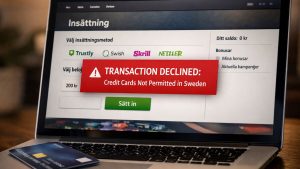
Sweden credit card gambling ban went into full effect this month, making the Nordic nation the first country in the European Union to completely prohibit players from funding online casino and sportsbook accounts with credit-based payment methods. The ban, enforced by the Swedish Gambling Authority Spelinspektionen starting April 1 2026, covers credit cards, personal loans, overdraft facilities, and buy-now-pay-later services like Klarna and Afterpay.
Sweden Credit Card Gambling Ban Closes a Major Loophole
Swedish regulators had flagged credit-funded gambling as a growing risk factor for problem gambling since at least 2022. Internal Spelinspektionen data released alongside the ban showed that roughly 18 percent of all deposits on licensed Swedish gambling sites in 2025 were made using credit instruments, with an average credit-funded deposit nearly three times larger than those made via debit cards or bank transfers.
The new rules require every licensed operator in Sweden to implement payment-method verification at the point of deposit. Operators must use bank identification protocols to confirm that incoming funds originate from a debit account, e-wallet preloaded with non-credit funds, or direct bank transfer. Any transaction flagged as credit-sourced must be automatically declined, and operators face penalties of up to 10 percent of annual Swedish revenue for systematic noncompliance.
How Operators Are Adapting to the Sweden Credit Card Gambling Ban
Major operators including Kindred Group, Betsson, and LeoVegas parent MGM Resorts International confirmed in Q1 earnings calls that they had completed technical integrations ahead of the April deadline. Kindred CEO Nils Andén described the transition as operationally smooth and noted that deposit volumes shifted primarily toward the Swish mobile payment platform and Trustly instant banking, both of which pull directly from debit accounts.
Smaller operators and white-label platforms reported more friction. Several mid-tier brands temporarily paused Swedish-facing operations during the final weeks of March to complete compliance testing, and at least two operators received formal warnings from Spelinspektionen for failing to block credit card transactions during a soft-launch grace period in February.
Wider EU Implications and the Credit Gambling Debate
The Swedish model is already influencing regulatory conversations across the EU. The Netherlands’ Kansspelautoriteit (KSA) published a consultation paper in March 2026 exploring similar restrictions, while Belgium’s Gaming Commission requested a comparative analysis of the Swedish framework as part of its own ongoing review of payment standards for licensed operators.
In the United Kingdom, the Gambling Commission introduced partial credit card restrictions for online gambling in 2020 but stopped short of banning overdrafts and BNPL products. The Sweden credit card gambling ban goes further by closing those gaps entirely, setting what consumer advocates call the new gold standard for payment-related player protection in regulated markets.
Sweden Credit Card Gambling Ban and Its Effect on Channelization
Critics of the ban warned that overly strict payment controls could push some Swedish players toward unlicensed offshore operators that accept a wider range of payment methods without verification. Spelinspektionen director-general Camilla Rosenberg addressed this concern directly in an April press briefing, stating that channelization rates in the Swedish market have remained stable at approximately 82 percent since the ban took effect and that the authority’s enforcement team is actively monitoring DNS and payment data for signs of migration to unlicensed sites.
The agency also announced an expanded cooperation agreement with major Swedish banks to flag and report any domestic credit transactions routed to known offshore gambling domains. This bank-level enforcement layer adds a secondary barrier that goes beyond what most EU regulators have attempted so far.
For players in markets across Asia-Pacific, including those using platforms reviewed on our Singapore casino reviews page, the Swedish approach offers a preview of where responsible payment regulation may be heading globally.
The broader trend is clear. From the EU Anti-Money Laundering Authority (AMLA) framework to national-level payment bans, European regulators are tightening the financial infrastructure around online gambling with a level of specificity that would have been unthinkable five years ago. Sweden is simply the first to draw the hardest line on credit, and the rest of the continent is watching closely to see whether the model holds.
For official details on the Swedish regulation, see Spelinspektionen’s official regulatory portal for enforcement guidance and compliance timelines.



How Online Gambling Payments Work Online

Free Credit No Deposit Casino Malaysia 2026: How to Claim RM20+ Bonuses at Trusted Online Casino Sites

Free Credit No Deposit Casino Malaysia 2026: How to Claim RM20+ Bonuses at Top Sites

Esports Betting Guide: How It Works and Risks

Best E-Wallet Casinos in Malaysia (April 2026): Complete Guide to TNG, GrabPay, and Secure Deposits

Best E-Wallet Casinos in Malaysia (2026 Guide)

Top 7 Best Casino Welcome Bonuses in Malaysia (2026)

How Online Sports Betting Really Works

Best E-Wallet Casinos in Malaysia: Top 7 Picks (2026)
