
Legal & Regulation
Malaysia’s 2026 Anti-Online Gambling Reform: Betting Act Amendments, MCMC Blocks & Influencer Enforcement

Overview – Why Malaysia Is Escalating Its Anti-Online Gambling Strategy in 2026
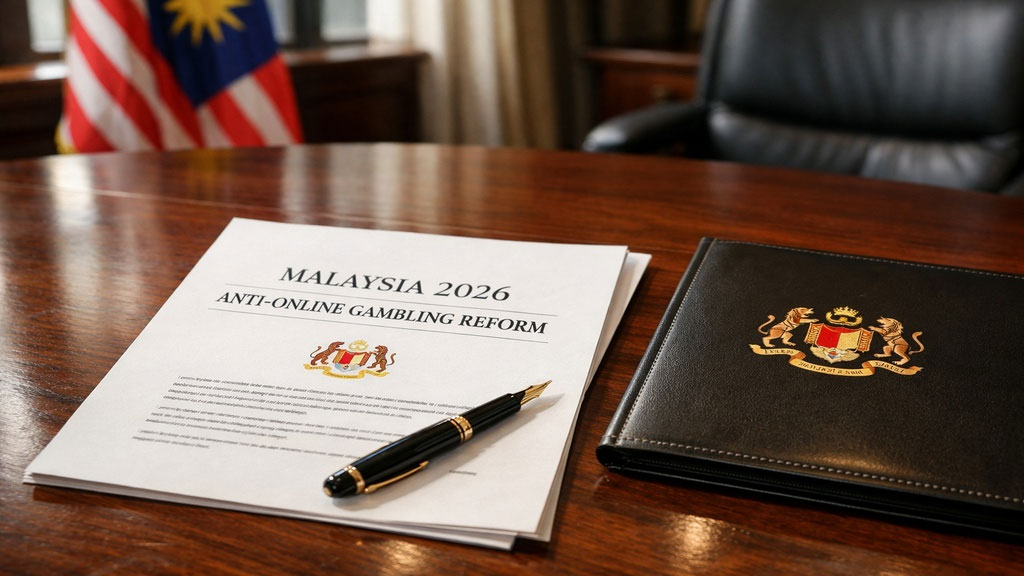
Malaysia is not messing around when it comes to online gambling in 2026. After decades of relying on laws written in 1953 — laws that predate the internet, smartphones, and social media — the country is finally overhauling its entire approach to digital gambling enforcement.
The Malaysia anti-online gambling reform 2026 is not about legalising or regulating the industry. It is about shutting it down more effectively. The approach combines new legislation, aggressive website blocking, and a crackdown on the influencers and social media figures who promote illegal gambling platforms to millions of followers.
So why is 2026 a turning point? Several forces have converged at once. Offshore platforms have multiplied and now offer Bahasa Malaysia interfaces, accept ringgit, and target Malaysian users specifically. Social media has become the primary advertising channel for illegal operators. And the old laws have repeatedly failed in court because they simply do not contain the words “online gambling.”
The government has seen enough. Deputy Prime Minister Fadillah Yusof has publicly stated that illegal gambling threatens the younger generation’s financial stability and social well-being. Prime Minister Anwar Ibrahim has pointed to a staggering revenue loss — the government loses an estimated RM2 billion in taxes annually to illegal online betting. Other estimates put the total illegal gambling market at RM18 billion per year.
The reform is enforcement-focused at its core. There is no pathway to domestic licensing. Instead, the strategy expands technical suppression through ISP-level DNS blocking, ramps up MCMC’s powers to remove content, and builds criminal liability for everyone in the gambling chain — from operators to affiliates to individual players.
What Is Malaysia’s Anti-Online Gambling Reform 2026?
Malaysia’s anti-online gambling reform 2026 refers to a coordinated government strategy to strengthen enforcement against illegal digital gambling activities. The reform focuses on updating legacy gambling laws, expanding enforcement powers, and introducing new mechanisms to disrupt online gambling ecosystems.
Rather than creating a legal framework for online casinos, the policy direction is explicitly restrictive. It combines proposed amendments to the Betting Act 1953, large-scale website blocking under the Communications and Multimedia Act 1998 (CMA), and increased enforcement against digital promoters such as influencers and affiliates.
The reform also reflects a shift toward technology-driven enforcement. Authorities are increasingly relying on ISP-level filtering, platform cooperation, and automated monitoring tools to detect and remove gambling-related content. Taken together, these measures represent Malaysia’s transition from reactive enforcement to a more integrated, system-level approach to combating illegal online gambling.
Beyond the Headlines: What’s Really Changing in Malaysia’s 2026 Gambling Reform
A lot of reporting on this reform focuses on headline numbers — how many sites have been blocked, how many people were arrested. But the deeper story is about structural change. Here is a snapshot of what is actually shifting across each area of the reform:
| Reform Area | Core Focus | Key Change |
| Betting Act 1953 | Modernisation of 1953 law | RM100k player penalty, digital definitions |
| MCMC Blocks | Section 263 CMA 1998 | 5,000+ sites blocked; government-led enforcement push |
| DNS Proxy | ISP-level filtering | Transparent DNS redirect by TM, Maxis, Time |
| Influencer Enforcement | Social media crackdown | AI-assisted detection; 27 arrests in 2024 |
| Platform Licensing | ASP(C) licence mandate | 8M+ user threshold from Jan 2026 |
Each of these areas is interconnected. The Betting Act amendments create the legal foundation. MCMC blocks and DNS proxy enforcement are the technical infrastructure. And the influencer crackdown is the demand-suppression layer that targets visibility before a user ever reaches a gambling site.
Malaysia Betting Act Amendments 2026 – Modernising a 1953 Framework
The Betting Act 1953 and the Common Gaming Houses Act 1953 are the two pillars of Malaysia’s gambling law. Both were written before computers existed. Neither contains the phrase “online gambling.” That is not a technicality — it is the reason prosecutors have repeatedly struggled to secure convictions for digital gambling offences.
A landmark court ruling exposed the gap. In Public Prosecutor v Multi Electrical Supply & Services, the High Court ruled that Section 4B of the Common Gaming Houses Act — which governs “gaming machines” — could not be applied to online gambling. The legislation simply did not cover digital environments.
This ruling effectively handed illegal online operators a legal shield. As long as they operated digitally, the existing law could not clearly reach them. The Malaysia gambling law reform 2026 is designed to close that gap permanently.
The Royal Malaysian Police’s Commercial Crime Investigation Department has submitted 12 proposed amendments. The government is debating whether to introduce these as a standalone act or incorporate them into existing legislation. Officials are also considering whether to integrate online gambling offences into a broader proposed Cyber Crime Bill, treating digital gambling as part of the wider criminal technology environment.
Key Categories of the Proposed Amendments
The 12 proposed amendments span six major areas, each addressing a specific gap in Malaysia’s current legal framework against illegal online gambling.
1. Expanded Legal Definitions
The most foundational change is simply adding the term “remote gambling” to the statute and defining digital platforms as falling within the law’s scope. Without this, courts continue to find loopholes. With it, prosecutors have a clear statutory basis for charging operators and facilitators of digital gambling services.
- Online betting platforms explicitly brought within statutory scope
- Digital intermediaries and platform facilitators covered under enforcement
- “Gaming house” redefined to reflect online environments
2. Increased Penalties and Player-Level Liability
This is where the Malaysia Betting Act amendments 2026 signal their most significant philosophical shift. Rather than targeting only operators, the new framework extends liability to individual players and digital facilitators.
- Proposed fines for individual players may reach up to RM100,000 and six months in jail, subject to the final legislative draft
- Operators face fines up to RM1 million and up to 12 months imprisonment
- Structural shift from operator-focused enforcement to demand-side deterrence
- Extends liability beyond traditional gaming house operators
This approach mirrors deterrence strategies used in other jurisdictions where making participation itself a higher-risk act reduces the user base that operators rely on.
3. Advertising and Promotion Liability
The reform explicitly criminalises the promotion of illegal gambling services through digital channels. This is not a minor technical change — it targets the entire affiliate and influencer marketing ecosystem that now drives most illegal gambling traffic in Malaysia.
- Digital promotion of illegal gambling classified as a criminal offence
- Influencer and affiliate marketing explicitly within enforcement scope
- Liability for facilitating traffic generation and referral-based promotion
4. Investigative, Digital Evidence and Asset Powers
The 2026 amendments also strengthen how law enforcement can investigate and prosecute online cases. Electronic documents are to be accepted as legal evidence in court — a critical gap that has hampered prosecutions to date.
- Broader authority to investigate digital gambling networks
- Electronic documents admissible as court evidence
- Enhanced powers to freeze and seize proceeds from illegal gambling
- MCMC and the deputy public prosecutor empowered to block gambling websites and freeze related bank transactions
MCMC Gambling Blocks and Section 263 CMA 1998 Enforcement Powers
Legal Authority: How MCMC Blocks Gambling Sites
The legal backbone of Malaysia’s website blocking regime is Section 263 of the Communications and Multimedia Act 1998 (CMA). This provision empowers the Malaysian Communications and Multimedia Commission (MCMC) to direct licensed internet service providers to block access to unlawful online content — including illegal online gambling websites. ISPs are legally required to comply, and non-compliance can result in regulatory penalties.
What is notable about the 2024 and 2025 enforcement surge is that blocking directives do not come from MCMC alone. Under the CMA framework, other government agencies — including the Ministry of Domestic Trade — can instruct ISPs directly to block specific sites, copying MCMC into the directive. This distributed authority explains how the volume of blocks accelerated so rapidly.
| Key Statistic
Over 5,026 gambling websites have been blocked as of early 2025, and in just the first 15 days of 2026 alone, MCMC removed 15,519 pieces of online gambling content. |
The Scale of MCMC Gambling Blocks in 2025–2026
The numbers tell a clear story. Between January 2020 and August 2024, over 20,000 websites were blocked in total across all categories. Of these, 4,482 were online gambling websites, making illegal gambling the single largest category of blocked content — accounting for 95.7% of all blocked sites alongside pornography, copyright infringement, and scam content.
By February 2025, the MCMC had removed 224,403 pieces of gambling-related content. By August 2025, more than 558,000 illegal posts had been removed since January 2022, with over 321,000 linked to gambling. The blocking effort has shifted from reactive takedowns to coordinated infrastructure enforcement.
Website blocking requests submitted by police to MCMC also surged dramatically — from 373 cases in 2021 to 1,922 cases in 2023, a fivefold increase in just two years. That trend has continued into 2026.
Transparent DNS Proxy Malaysia – Strengthening ISP-Level Gambling Blocks
Standard DNS blocking always had an obvious weakness. A user who simply changed their device’s DNS settings to use Google’s public server (8.8.8.8) or Cloudflare (1.1.1.1) could bypass MCMC blocks entirely. For years, this was a well-known workaround.
Malaysia attempted to close this loophole through transparent DNS proxying — a more sophisticated form of ISP-level filtering. Instead of just blocking certain domains at the DNS level, ISPs intercept DNS queries directed at external servers and silently redirect them through their own systems. A user who thinks they are querying Google’s DNS server is actually having their request processed locally, with MCMC block lists applied regardless.
In August 2024, it was confirmed that major Malaysian ISPs — including Maxis and Time — had implemented exactly this kind of transparent DNS proxy. Users configuring their devices to use alternative DNS providers found they were still unable to reach blocked gambling websites. TM, U Mobile, and CelcomDigi were also among the ISPs involved in the broader rollout.
The technical effect is significant: it defeats the most common bypass method used by ordinary users. However, it is not a complete seal. Secure DNS protocols — specifically DNS over HTTPS (DoH) and DNS over TLS (DoT) — encrypt DNS queries and can prevent ISPs from intercepting them. VPNs also remain an effective workaround.
| Policy Note
Following public backlash about potential overreach — including concerns that legitimate news and election result websites were inadvertently blocked — Communications Minister Fahmi Fadzil instructed MCMC to pause aspects of the transparent DNS proxy rollout. The situation underscores the tension between enforcement effectiveness and civil liberties. |
Influencer Crackdown and Demand Suppression Strategy (2025–2026)
The Scale of the Social Media Problem
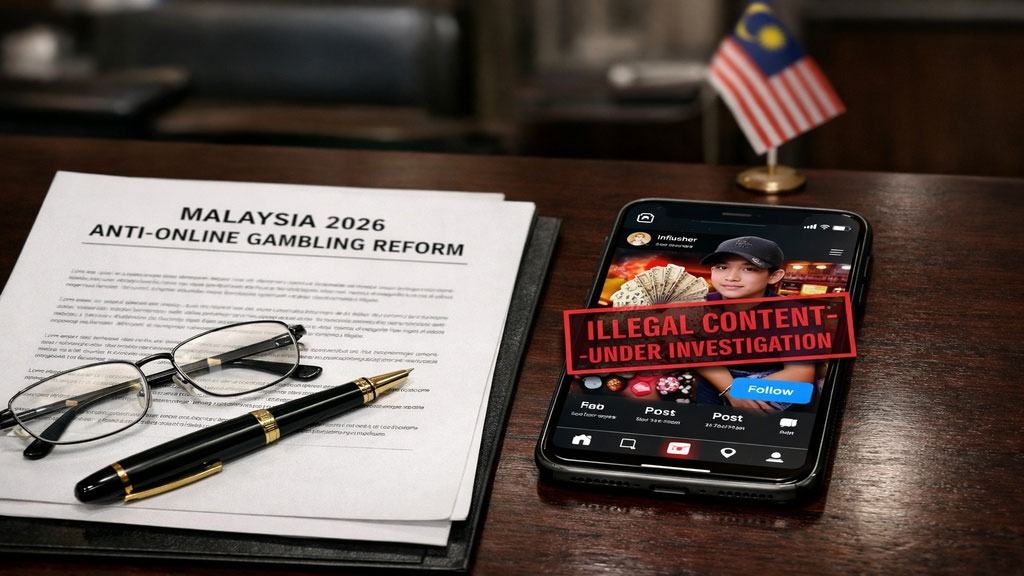
Illegal gambling syndicates have fundamentally shifted their marketing strategy. They no longer rely primarily on banner ads or spam emails. Instead, they recruit social media influencers — people with real followings and trusted voices — to promote their platforms as entertainment or harmless fun.
The numbers are stark. Facebook alone accounts for around 93% of all reported illegal gambling advertisements in Malaysia. Between 2022 and early 2025, approximately 209,000 out of 224,403 total removed gambling posts came from Facebook. TikTok has also become a major channel, particularly for reaching younger audiences.
The promotional ecosystem includes sponsored posts, livestreams, referral links, promo codes, and Telegram groups used for coordinating affiliate payments. It functions like a professional marketing industry — except that the product it is selling is illegal.
Legal Liability for Digital Promotion
The Commercial Crime Investigation Department opened 28 investigation papers involving influencers promoting gambling sites in 2024 alone. According to reports, at least 27 individuals were arrested in 2024 for promoting illegal gambling platforms (Astro Awani). Of those, 18 cases have proceeded to charge, and 10 remain under active investigation.
Under the amended Betting Act framework, criminal liability for digital promotion is being formalised. This means influencers, affiliates, and content creators who drive traffic to illegal gambling platforms face the same legal exposure as the operators themselves. MCMC and PDRM are cooperating closely on these cases, with content removal orders issued in parallel with criminal investigations.
AI-Enhanced Monitoring and Livestream Detection
One of the most forward-looking elements of the Malaysia gambling influencer crackdown is the use of AI-assisted monitoring tools. Authorities are moving away from purely complaint-based detection — waiting for reports from the public — toward proactive algorithmic scanning of social media content.
- Automated scanning of livestreams for gambling logos, brand visuals, and promotional imagery
- Detection of referral links, promo codes, and affiliate tracking URLs in post captions
- Monitoring of short-form video platforms including TikTok, Facebook Live, and Instagram Reels
- Data analytics used to trace promotional networks and identify repeat offenders
- Cross-platform coordination for faster content takedown requests
Authorities are also preparing for the next wave: AI-altered gambling videos. Police have confirmed they are developing investigative frameworks to handle AI-generated content used in gambling promotion — a challenge that makes the absence of clear “online gambling” definitions in existing law even more pressing.
The Demand Suppression Strategy
Malaysia’s enforcement model is not just about blocking websites. It is about eliminating visibility. The logic is simple: if a potential gambler never sees an advertisement, they are less likely to search for a platform in the first place.
This demand suppression approach combines platform-level content removal, criminal liability for promoters, algorithmic detection of gambling content, and mandatory social media licensing into one coordinated system. It targets the entire funnel — from the moment a user first encounters a gambling promotion to the point of account registration and first deposit.
What the 2026 Reform Means for Players and Offshore Operators
The practical implications of Malaysia’s 2026 anti-online gambling reform differ depending on who you are. For casual players who used offshore sites, the risk profile has changed. Player-level may fines of up to RM100,000 represent a serious financial deterrent that did not previously exist in any practical form.
For offshore operators, the environment is increasingly hostile. Many platforms serving Malaysian users are based in the Philippines, Cambodia, and Malta. While physical jurisdiction remains a challenge, the combination of ISP-level DNS blocking, transparent DNS proxying, and platform licensing requirements makes it harder to reach Malaysian users and harder to market to them.
The clearest impact is on affiliates and digital facilitators. The explicit criminalisation of gambling promotion — including referral links, influencer partnerships, and affiliate-style marketing — creates direct legal exposure for anyone driving traffic to illegal platforms, regardless of whether they operate the platform themselves.
- Individual players may face RM100,000 fines and six months in jail
- No domestic licensing pathway exists — this reform is purely restrictive
- Offshore operators face infrastructure constraints and reduced visibility
- Affiliates and digital promoters now carry explicit criminal liability
- Stronger evidence-gathering powers make prosecutions more likely to succeed
To understand how Malaysia’s enforcement strategy compares with neighbouring markets like Thailand and Singapore, read our Southeast Asia online gambling laws 2026 overview.
Malaysia’s 2026–2027 Outlook – Enforcement Over Legalisation
There is no ambiguity about the direction of Malaysia’s gambling policy. The 2026 reform is not the start of a legalisation or licensing conversation. It is a commitment to deeper, more technologically sophisticated enforcement of an existing prohibition.
The next phase of enforcement is likely to bring further upgrades to MCMC’s AI monitoring tools, expanded use of the ASP(C) licensing framework to hold platforms accountable, and continued legislative refinement as new amendments move through the Dewan Rakyat (Parliament of Malaysia). Cross-agency cooperation between MCMC, PDRM, and Bank Negara Malaysia — including the freezing of gambling-related bank transactions — is expected to intensify.
Malaysia is positioning itself as a firmly restrictive market. The technology-driven enforcement model now underway — combining DNS-level blocking, AI-assisted detection, influencer prosecution, and mandatory platform licensing — creates a multi-layered barrier that goes far beyond anything the country had in place just three years ago.
Key Takeaways – Malaysia’s Anti-Online Gambling Reform 2026
- Malaysia Betting Act amendments 2026 introduce explicit digital definitions closing a 70-year legal gap
- Individual players face fines up to RM100,000 — a structural shift to demand-side deterrence
- MCMC gambling blocks have scaled to over 5,000 sites, with 15,519 pieces of content removed in the first 15 days of 2026 alone
- Transparent DNS Proxy Malaysia strengthens ISP filtering by defeating manual DNS switching
- Section 263 CMA 1998 remains the core legal authority for website blocking directives
- Influencer gambling crackdown intensifies with 27 arrests in 2024 and AI-assisted monitoring expanding
- Social media platforms with 8M+ Malaysian users must now hold an ASP(C) licence from January 2026
- Reform signals stricter enforcement only — there is no legalisation pathway on the table
FAQ – Malaysia’s 2026 Anti-Online Gambling Reform
1. What is Malaysia’s anti-online gambling reform 2026?
Malaysia’s anti-online gambling reform 2026 is a government initiative to strengthen enforcement against illegal online betting. The reform includes amendments to the Betting Act 1953, large-scale website blocking by the Malaysian Communications and Multimedia Commission (MCMC), and stricter penalties for operators, players, and influencers promoting illegal gambling platforms.
2. Is online gambling illegal in Malaysia in 2026?
Yes. Online gambling remains illegal in Malaysia in 2026. The country does not offer a legal licensing system for online casinos or betting platforms. The reform focuses on enforcement measures rather than legalisation.
3. What are the key changes in the Malaysia Betting Act amendments 2026?
The proposed amendments introduce digital definitions for online gambling, higher penalties for operators and players, criminal liability for gambling promotions, and expanded investigative powers for law enforcement agencies to freeze assets and block gambling websites.
4. What penalties do players face under the new gambling laws?
Under the proposed amendments, individuals participating in illegal online gambling may face fines of up to RM100,000 and imprisonment for up to six months. This marks a shift toward demand-side enforcement targeting players as well as operators.
5. How does MCMC block illegal gambling websites?
The Malaysian Communications and Multimedia Commission blocks illegal gambling websites using powers under Section 263 of the Communications and Multimedia Act 1998. Internet service providers are legally required to block access to websites identified as hosting unlawful gambling content.
6. What is transparent DNS proxying in Malaysia?
Transparent DNS proxying is a technical filtering method used by Malaysian internet service providers to redirect DNS requests through their own systems. This prevents users from bypassing website blocks simply by switching to external DNS providers such as Google or Cloudflare.
7. Why is Malaysia targeting social media influencers in gambling enforcement?
Authorities believe influencers play a major role in promoting illegal gambling platforms to large online audiences. The reform makes digital promotion of illegal gambling a criminal offence, meaning influencers who advertise betting platforms may face investigation, fines, or prosecution.
8. How many gambling websites have been blocked in Malaysia?
Thousands of illegal gambling websites have already been blocked by Malaysian authorities. Enforcement has increased significantly in recent years, with thousands of websites and hundreds of thousands of gambling-related social media posts removed.
9. Can offshore gambling operators still target Malaysian users?
While offshore gambling platforms may still attempt to serve Malaysian users, new enforcement measures such as DNS blocking, payment monitoring, and stricter promotion laws make it significantly harder for these operators to access the Malaysian market.
10. Will Malaysia legalise online gambling in the future?
There is currently no indication that Malaysia plans to legalise online gambling. Government policy strongly favours stricter enforcement and technological controls rather than creating a regulated online gambling industry.
11. What role does AI play in Malaysia’s gambling enforcement strategy?
Authorities are increasingly exploring automated and AI-assisted monitoring tools to detect gambling promotions on social media platforms. These tools scan livestreams, videos, and posts for gambling logos, referral links, and promotional content linked to illegal betting networks.
12. How does the reform affect social media platforms operating in Malaysia?
Large digital platforms with millions of Malaysian users may be required to obtain regulatory licences and comply with stricter content moderation requirements. This includes removing gambling promotions and cooperating with enforcement agencies.






How Online Gambling Payments Work Online

Free Credit No Deposit Casino Malaysia 2026: How to Claim RM20+ Bonuses at Trusted Online Casino Sites

Free Credit No Deposit Casino Malaysia 2026: How to Claim RM20+ Bonuses at Top Sites

Esports Betting Guide: How It Works and Risks

Best E-Wallet Casinos in Malaysia (April 2026): Complete Guide to TNG, GrabPay, and Secure Deposits

Best E-Wallet Casinos in Malaysia (2026 Guide)

Top 7 Best Casino Welcome Bonuses in Malaysia (2026)

How Online Sports Betting Really Works

Best E-Wallet Casinos in Malaysia: Top 7 Picks (2026)
