
New York Fed Study Reveals Legal Sports Betting Drives 10% Surge in Credit Delinquencies Across 30 US States

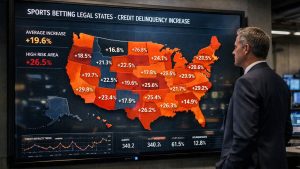
NEW YORK, April 5, 2026 — A landmark study by the Federal Reserve Bank of New York, released this week, has found compelling evidence that the rapid legalisation of sports betting across the United States is causing measurable financial harm to bettors, with credit delinquencies spiking more than 10% among those who took up wagering after their state legalised the activity.
Background
Since the US Supreme Court’s 2018 Murphy v. NCAA ruling struck down the federal prohibition on sports betting, more than 30 US states have legalised the activity. Mobile apps from operators such as DraftKings, FanDuel, BetMGM, and ESPN Bet have made wagering accessible around the clock, fuelling a multi-billion dollar industry now generating over $11 billion in annual gross gaming revenue.
While the industry has long argued it provides entertainment value and generates significant tax revenue, concerns about problem gambling, financial harm, and mental health impacts have grown steadily. The New York Federal Reserve study is among the most rigorous academic analyses to date to quantify the financial consequences of widespread sports betting access.
Key Details
The Federal Reserve study found that among the 3% of the US population that took up sports betting after legalisation in their state, credit delinquencies — primarily missed credit card and auto loan payments — spiked by over 10%. Even across the broader population in legalised states, overall credit delinquency rates rose approximately 0.3%.
The researchers documented “a substantial increase in average bankruptcy rates, debt sent to collections, use of debt consolidation loans, and auto loan delinquencies,” concluding that “the ease of access to sports gambling is harming consumer financial health by increasing their level of debt.” Young people under 40 were identified as the most financially at-risk demographic, with the sharpest declines in credit health concentrated in this age group.
Between December 2019 and June 2021, bettors more than doubled their quarterly gambling spending, from under $500 to over $1,000 per quarter — a trajectory researchers attributed largely to the proliferation of mobile betting apps and aggressive advertising campaigns by major operators.
Industry Impact
The study arrives at a politically sensitive moment for the US sports betting industry. Multiple states are currently reviewing their regulatory frameworks, and Congress has held preliminary hearings on federal-level oversight of online gambling advertising and player protections. The research is expected to be cited prominently in upcoming legislative debates about mandatory spending limits, cooling-off periods, and affordability checks — measures already introduced in the UK and Sweden.
According to NPR, advocacy groups have already begun calling on Congress to adopt a national framework for consumer financial protections in sports betting, similar to credit card protection legislation passed in recent years.
What This Means for Players
If you or someone you know is concerned about gambling-related financial difficulties, deposit limits and self-exclusion options are widely available across licensed gambling platforms. Players should always gamble with money they can afford to lose and seek support from organisations such as the National Council on Problem Gambling (NCPG). For those seeking safe, regulated entertainment options in Southeast Asia, a BK8 Casino Malaysia review provides insight into responsible, licensed play environments.
What’s Next?
The Federal Reserve study is expected to be peer-reviewed and formally published in an academic journal in the coming months. Regulators in several US states have indicated they are reviewing its findings. Industry groups, including the American Gaming Association (AGA), are likely to commission counter-research examining the broader economic benefits of legalised sports betting. Meanwhile, operators are under increasing pressure to demonstrate that their responsible gambling tools are genuinely effective — not merely regulatory checkbox items.



How Crypto Casino Payments Work: Wallets, Confirmations, and Risk Checks
Sent Crypto to Wrong Network? What You Can Recover and What You Can’t

Crypto Casino Withdrawal Fees Explained: What You Actually Pay

Why Is My Crypto Withdrawal Taking So Long? (Confirmations, Network, Fees)

USDT vs Bitcoin Casino Withdrawals: Speed, Fees & Risks Compared

Crypto vs E-Wallet Casino Withdrawals: Speed, Fees, Risks Compared

Responsible Gambling Controls in Regulated Markets (UK/AU) and How They Work

Name Mismatch: Why Wallet/Bank Names Must Match Casino Profiles

Best Casino Withdrawal Methods (Speed, Fees, Safety Compared)
