
Georgia Sports Betting Bill Failure Ends 2026 Legalization Push

By Sarah Mitchell, Senior Gaming Correspondent
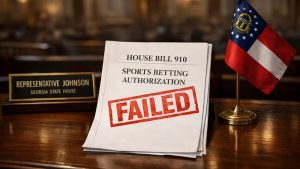
Georgia sports betting bill failure dominated statehouse headlines on Crossover Day 2026, when House Bill 910 fell dramatically short of the 120 votes needed to advance. The 63-to-98 tally sealed the fate of what many industry observers considered the Peach State’s most realistic shot at legalizing mobile sports wagering. The georgia sports betting bill failure carries broader implications for the US Southeast, where millions of bettors must continue to cross state lines or rely on offshore platforms while neighboring states pocket hundreds of millions in tax revenue.
Georgia Sports Betting Bill Failure: HB 910 Falls Far Short on Crossover Day
The numbers tell the story. HB 910 needed a two-thirds supermajority — 120 affirmative votes — to clear the Georgia House on March 6, 2026. It received barely half that. The bill would have authorized up to 18 online sportsbook licenses administered by the Georgia Lottery Corporation, with no physical sportsbooks, casinos, or racetracks attached. Each operator would have paid a $100,000 non-refundable application fee and a $1.5 million annual license fee, generating tens of millions in state revenue earmarked for pre-K education through a dedicated fund.
Representative Ron Stephens, who has pushed versions of this legislation since 2019, framed the vote as a once-in-a-session opportunity. The bill was scheduled for Crossover Day — the final deadline for legislation to pass from one chamber to the other — and the American Gaming Association estimated Georgia could generate between $350 million and $500 million in annual handle if it joined the 38 states that already permit legal sports wagering in some form.
Why the Peach State Keeps Rejecting Gambling Expansion
Georgia’s repeated georgia sports betting bill failure is not a one-off event. Versions of this legislation have been introduced in nearly every session since the US Supreme Court struck down PASPA in 2018, yet the political math has never changed enough to deliver a win. The bill’s opponents fall into several overlapping camps: fiscal conservatives who worry about social costs, rural lawmakers with strong ties to evangelical constituencies, and members who believe gambling expansion should require a constitutional amendment rather than statutory authorization.
HB 910 tried to sidestep the constitutional question by structuring sports betting as a lottery product, which would allow it to pass through ordinary legislation. A parallel effort, House Resolution 450, pursued the constitutional-amendment path but never gained committee traction. Both approaches foundered on the same underlying reality: a Republican supermajority that is philosophically divided on gambling, with a 76-to-29 advantage in the House that masks deep internal disagreement on the issue.
Education Revenue and the Financial Cost of Inaction
Supporters pointed to the education revenue component as a key differentiator. Under HB 910, all net sports betting revenue would have flowed into a newly created fund supporting Georgia’s pre-K programs — a direct investment in one of the state’s most popular and politically protected public services. A Georgia Senate study committee on tourism published a report in December 2025 recommending legalization, citing the education funding pipeline as a major justification.
Neighboring states have already pocketed significant revenue from legal wagering. Tennessee, which launched mobile-only sports betting in November 2020, collected over $230 million in privilege taxes through 2025. North Carolina, which went live with mobile betting in March 2024, generated $85 million in its first full fiscal year. The georgia sports betting bill failure means Georgia continues to forfeit that revenue while its residents place bets through unregulated channels.
For bettors in the Southeast seeking legal and licensed alternatives, regulated online casino platforms in Malaysia offer a useful reference point for how licensed jurisdictions balance market access with player protections — a framework Georgia has yet to develop for itself.
What Comes Next for Georgia Wagering Advocates
The immediate outlook is clear: no legal sports betting in Georgia until at least the 2027 legislative session. Proponents have already signaled they will reintroduce legislation, though the political calculus is unlikely to shift dramatically without major electoral changes. The 2026 midterm elections could reshuffle the deck if suburban swing districts elect members more sympathetic to gambling expansion, but statewide polling shows support hovering around 55 to 60 percent — enough for a public referendum to pass, yet not enough to convince supermajority-averse lawmakers to take the risk.
Industry analysts from Eilers & Krejcik Gaming estimate that the georgia sports betting bill failure costs the state approximately $45 million to $70 million per year in unrealized tax revenue. That figure will only grow as the national market matures and handle increases. Between Georgia, Texas, and California, roughly 85 million Americans live in states that have yet to legalize sports betting — a fact that underscores how incomplete the US rollout remains nearly eight years after PASPA fell.
A Pattern That May Eventually Break
Georgia is not unique in struggling to pass gambling legislation, but it is the most populous holdout state where a concrete bill has repeatedly reached a floor vote. The georgia sports betting bill failure pattern — strong public support, organized industry lobbying, and persistent legislative resistance — mirrors what Texas has experienced on a larger scale. Both states will be closely watched in coming sessions as the national conversation around sports betting shifts from expansion to optimization, with tax rates, responsible gambling mandates, and market structure now dominating policy debates in states that have already said yes.
Until Georgia resolves its own internal debate, its residents will continue watching from the sidelines while Tennessee, North Carolina, Virginia, and Missouri compete to capture the region’s multibillion-dollar appetite for legal sports wagering.









Why Is My Crypto Withdrawal Taking So Long? (Confirmations, Network, Fees)

USDT vs Bitcoin Casino Withdrawals: Speed, Fees & Risks Compared

Crypto vs E-Wallet Casino Withdrawals: Speed, Fees, Risks Compared

Responsible Gambling Controls in Regulated Markets (UK/AU) and How They Work

Name Mismatch: Why Wallet/Bank Names Must Match Casino Profiles

Best Casino Withdrawal Methods (Speed, Fees, Safety Compared)

AML in iGaming: Common Red Flags That Trigger Reviews

8 Nhà Cái Uy Tín Nhất Hiện Nay Tại Việt Nam Với Ưu Đãi Tặng Tiền Và Tỷ Lệ Cược Hấp Dẫn

How Online Gambling Payments Work Online
