
Netherlands KSA Licensing Overhaul Sets Stricter Standards for Online Operators

By James O’Connor, Regulation Editor
Netherlands KSA Licensing Overhaul Raises the Bar for Online Operators
Netherlands KSA licensing overhaul measures that took effect on January 1, 2026, are already reshaping how online gambling operators enter and remain in one of Europe’s most competitive regulated markets. The Kansspelautoriteit, the Dutch gambling authority, published its updated Beleidsregels vergunningverlening kansspelen op afstand 2026 — the Remote Gambling Policy Rules 2026 — which impose stricter documentation obligations, enhanced reliability clauses, and a significantly more rigorous evaluation process for every operator seeking or renewing a remote gambling license in the Netherlands.
The timing is deliberate. Since the Dutch market opened to private operators in October 2021, the KSA has faced sustained criticism from parliamentarians and consumer advocacy groups who argued that initial licensing standards were too lenient, allowing operators with questionable compliance histories in other jurisdictions to secure Dutch permits with minimal friction. The netherlands KSA licensing overhaul is the regulator’s direct response: a framework designed to filter out operators who treat the Netherlands as a secondary market rather than a core compliance commitment.
Five Enforcement Priorities Driving the Netherlands KSA Licensing Overhaul
The KSA’s 2026 supervisory agenda identifies five areas that will receive concentrated enforcement resources throughout the year: combating illegal gambling, protecting vulnerable groups with an emphasis on players aged 18 to 24, monitoring operator duty of care, enforcing advertising restrictions, and ensuring anti-money-laundering compliance. Each priority maps directly to a licensing condition, meaning that failures in any category can trigger not only fines but also license suspension or revocation proceedings. The regulator has publicly stated its goal of keeping at least 90 percent of Dutch players within the legal channel while reducing the revenue flowing to unlicensed offshore platforms.
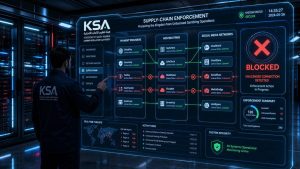
That channelization target carries real enforcement teeth. The KSA has signaled it will expand its approach beyond targeting individual illegal operators and instead go after the infrastructure that supports them — payment providers processing transactions for unlicensed sites, hosting firms keeping illegal platforms accessible, and social media networks running advertising for operators without Dutch permits. This supply-chain enforcement strategy borrows heavily from the model deployed by the UK Gambling Commission and Italy’s ADM, both of which have seen measurable reductions in black-market traffic after pressuring upstream service providers.
Financial Continuity and Reliability Clauses Tighten
Under the revised licensing rules, applicants must now demonstrate financial continuity through audited statements covering at least three fiscal years, with specific solvency ratios that the KSA will assess independently rather than accepting operator self-certifications. The enhanced reliability clauses extend personal background checks to a broader set of individuals connected to the applicant entity, including beneficial owners holding stakes as low as 10 percent, board members of parent companies, and key compliance personnel identified by name in the application. Previously, background scrutiny applied primarily to direct shareholders and the applicant’s own board.
This expansion of the reliability perimeter addresses a known gap in the original framework. Several operators that received licenses in 2021 and 2022 were later found to have indirect ownership connections to entities sanctioned or fined in other jurisdictions. The netherlands KSA licensing overhaul closes that gap by requiring applicants to disclose and document the full corporate chain of control, including offshore holding structures, and to update that disclosure within 30 days of any ownership change occurring post-licensing.
Governance Restructuring at the KSA Itself
The regulatory tightening coincides with an internal reorganization at the KSA. Effective January 1, 2026, the authority operates under a new governance structure: one full-time chair supported by two part-time directors, overseeing three principal directorates. The restructuring consolidates decision-making authority and is designed to reduce the lag between investigation findings and enforcement actions, which industry observers had criticized as a structural weakness during the regulator’s first four years of overseeing the liberalized market.
Operators serving markets across Southeast Asia, including Singapore’s tightly regulated casino environment, will recognize the KSA’s trajectory. Mature regulatory markets tend to follow a predictable arc: an initial liberalization phase focused on market entry, followed by a consolidation phase where compliance standards ratchet upward and enforcement becomes more aggressive. The netherlands KSA licensing overhaul places the Dutch market firmly in that second phase, with operational consequences for every licensed operator and every company considering a Dutch market application.
What Licensed Operators Must Do Now
The practical compliance burden is substantial. Licensed operators must complete a full self-assessment against the 2026 policy rules by mid-year, submit updated corporate disclosure packages, and demonstrate that their duty-of-care systems — particularly real-time behavioral monitoring and affordability intervention triggers — meet the KSA’s updated expectations. The ICLG Netherlands Gambling Report notes that several operators are already investing in RegTech upgrades to automate the continuous compliance monitoring that the netherlands KSA licensing overhaul effectively mandates.
For prospective applicants, the message is equally clear: the window for entering the Dutch market on thin credentials has closed. The KSA expects operators to arrive with clean compliance records, robust corporate transparency, and operational systems already calibrated to Dutch standards — not to build them after receiving a license. With license renewal cycles beginning for the first cohort of 2021 licensees, the netherlands KSA licensing overhaul will serve as both a gatekeeper for new entrants and a stress test for incumbents over the next 12 months.






Are Crypto Casino Payments Anonymous? (Reality vs Myth)

How Crypto Casino Payments Work: Wallets, Confirmations, and Risk Checks

Sent Crypto to Wrong Network? What You Can Recover and What You Can’t

Crypto Casino Withdrawal Fees Explained: What You Actually Pay

Why Is My Crypto Withdrawal Taking So Long? (Confirmations, Network, Fees)

USDT vs Bitcoin Casino Withdrawals: Speed, Fees & Risks Compared

Crypto vs E-Wallet Casino Withdrawals: Speed, Fees, Risks Compared

Responsible Gambling Controls in Regulated Markets (UK/AU) and How They Work

Name Mismatch: Why Wallet/Bank Names Must Match Casino Profiles
