
Michigan iGaming Revenue Record Reaches $322 Million as FanDuel Leads All Operators

By Sarah Mitchell, Senior Gaming Correspondent
Michigan iGaming revenue record figures shattered expectations in March 2026, with the state’s licensed online casino operators generating $322.1 million in gross gaming receipts — the highest monthly total since Michigan launched its regulated digital gambling market in January 2021. The Michigan Gaming Control Board confirmed the milestone on April 20, cementing the Great Lakes State’s position as one of America’s most lucrative iGaming jurisdictions.
Michigan iGaming Revenue Record: The Numbers Behind the Surge
The $322.1 million gross revenue figure represents a year-over-year increase of 23.6 percent compared to March 2025, when operators reported $260.5 million. It also surpasses the previous monthly high of $315.8 million set in December 2025 by more than $6 million. When combined with online sports betting receipts, Michigan’s total digital gambling gross reached $372.1 million in March — an 18.9 percent jump over February’s combined numbers.
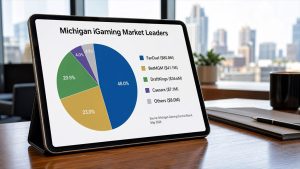
FanDuel Casino dominated the competitive field, posting $85.8 million in single-month revenue, a new record for any individual Michigan operator. BetMGM and DraftKings followed as strong runners-up. Together, the top three operators accounted for roughly 65 percent of all michigan igaming revenue record totals for the period, demonstrating how heavily the market tilts toward established brands with deep marketing budgets and extensive game libraries.
State Tax Revenue Soars Past $87 Million
Michigan’s tiered tax structure on iGaming profits generated $64.1 million for the state treasury and an additional $23.6 million for city and local jurisdictions. Those numbers matter for lawmakers who have long framed digital gambling expansion as a funding mechanism for infrastructure, education, and municipal services. Over the trailing twelve months, Michigan has collected more than $900 million in combined iGaming and online sports betting taxes — a persuasive data point for states still debating legalization.
The michigan igaming revenue record results also coincide with growing legislative attention in neighboring states. Ohio, which legalized online sports betting in 2023, is now weighing standalone iCasino legislation. Indiana lawmakers have similarly floated proposals. Michigan’s consistent upward revenue trajectory provides the clearest economic case for expansion advocates in the Midwest, giving lobbyists and fiscal analysts a concrete benchmark to cite.
Why Michigan Keeps Outperforming Other Markets
Several structural advantages explain why Michigan’s iGaming market continues to set records. First, the state allows both commercial and tribal operators to offer online casino games, broadening the licensed operator pool beyond what states like New Jersey or Pennsylvania permit. Second, Michigan’s regulatory framework imposes relatively streamlined compliance requirements, encouraging operators to invest in product innovation and player acquisition rather than drowning in administrative overhead.
Player demographics play a role as well. Michigan’s adult population of roughly 7.8 million is highly concentrated in metropolitan areas — Detroit, Grand Rapids, Ann Arbor — with strong broadband penetration. That urban density translates into higher per-capita engagement with mobile casino apps. Average monthly active users on Michigan-licensed platforms rose 19 percent year-over-year, according to industry analysts tracking the space.
For players in Southeast Asia exploring similar operator-grade platforms, trusted online casinos in Malaysia offer a comparable range of live dealer tables and slot titles from the same global software providers powering Michigan’s top performers.
FanDuel’s Competitive Edge in the State
FanDuel’s record-breaking month did not happen by accident. The Flutter Entertainment subsidiary invested heavily in exclusive slot partnerships, accelerated withdrawal processing, and a revamped loyalty program launched in February 2026. FanDuel Casino now offers more than 1,400 titles in Michigan — roughly 200 more than its closest competitor — and its average session length reportedly sits at 22 minutes, the highest among major operators active in the state.
The michigan igaming revenue record performance also reflects FanDuel’s cross-selling strategy, funneling sports bettors from its dominant sportsbook into the casino vertical through integrated promotions. That playbook mirrors what PENN Entertainment and BetMGM have attempted, though FanDuel’s execution has been considerably more consistent in Michigan throughout 2025 and early 2026.
What the Michigan iGaming Revenue Record Means for Federal Policy
Michigan’s March results arrive at a sensitive moment in federal gambling politics. Multiple congressional proposals have sought to impose a national framework on online gambling, ranging from interstate compacts to uniform age-verification standards. Supporters of state-level regulation point to Michigan’s track record as evidence that local oversight works: tax receipts are climbing, problem gambling referrals remain stable at roughly 0.3 percent of active players, and the unlicensed offshore market share has declined by an estimated 40 percent since launch.
Opponents counter that a patchwork of 30-plus state regimes creates compliance burdens for operators and confusing jurisdictional rules for players who travel. The Michigan Gaming Control Board’s official March revenue report nonetheless provides hard data that decentralized regulation can produce strong fiscal outcomes without the federal overhead that critics often demand.
The michigan igaming revenue record streak shows no signs of stalling. Industry forecasts project Michigan will cross $4 billion in annual iGaming gross receipts by 2027, potentially overtaking New Jersey as the nation’s second-largest digital casino market behind Pennsylvania. Whether that projection holds depends on operator investment, regulatory stability, and the broader macroeconomic environment — but March 2026 suggests the momentum is firmly in Michigan’s favor.






Crypto vs E-Wallet Casino Withdrawals: Speed, Fees, Risks Compared

Responsible Gambling Controls in Regulated Markets (UK/AU) and How They Work

10 Best Online Casino Singapore Sites Ranked and Reviewed

Name Mismatch: Why Wallet/Bank Names Must Match Casino Profiles

Best Casino Withdrawal Methods (Speed, Fees, Safety Compared)

AML in iGaming: Common Red Flags That Trigger Reviews

8 Nhà Cái Uy Tín Nhất Hiện Nay Tại Việt Nam Với Ưu Đãi Tặng Tiền Và Tỷ Lệ Cược Hấp Dẫn

How Online Gambling Payments Work Online

Free Credit No Deposit Casino Malaysia 2026: How to Claim RM20+ Bonuses at Trusted Online Casino Sites
